






Can personal loans be used for home improvements? The short answer is yes, and for many of us, it is actually the most direct route to getting that kitchen remodel or new roof started without waiting years to save the cash. While most people assume you need a massive mortgage adjustment to change your living space, the reality of modern financing is much more modular and, frankly, a lot faster.
When we look at a house, we often see a finished product, but anyone who has lived in a home for more than three years knows it is actually a living, breathing entity that requires constant attention. A leaky faucet is a nuisance, but a failing HVAC system or a sagging porch is a financial crisis waiting to happen. This is where the distinction between “want” and “need” becomes a very expensive line in the sand.
We have seen neighbors take out massive loans for aesthetic upgrades like granite countertops, only to realize later that the money would have been better spent on the structural integrity of their foundation. This is why understanding the specific mechanics of different loan types is the difference between a home that grows in value and a home that becomes a debt trap. We need to look at how the money actually moves from the bank to your contractor.
The most common path for quick fixes is the unsecured personal loan. These don’t require you to put your house up as collateral, which means if things go south, your home isn’t immediately on the chopping block. It sounds like a relief, but that lack of collateral is exactly why the interest rates tend to be higher than a traditional mortgage-based loan. You are paying for that flexibility and speed.
Decoding the Unsecured Advantage
The term “unsecured” sounds intimidating, but in the world of home finance, it is actually a safety net for your equity. Most people assume that to get money for a renovation, you have to tap into the value of the house itself. That is not true. An unsecured loan is a personal loan for home repairs, appliances, remodels, and more, where you are essentially borrowing based on your creditworthiness rather than your property’s appraised value.
Take, for example, a homeowner named Sarah in Austin. She wanted to replace her aging, 25-year-old roof before the heavy storm season hit. She didn’t want to touch her home equity line of credit because she was worried about the rising interest rates affecting her primary mortgage, so she went the personal loan route. She needed $18,000 quickly. Within a week, the funds were in her account, and the roofing crew was on her driveway. She didn’t have to wait for a full home appraisal or deal with the massive paperwork of a traditional bank refinance.
If you look at the current market, the options are quite varied depending on what you need. For those looking for a more substantial amount with a bit more structure, personal loans for home improvement can offer amounts up to $50,000 with an APR as low as 9.24%. This is a significant chunk of change that can cover a bathroom gut-reno or a high-end appliance package. It is a middle ground between a tiny credit card limit and a massive mortgage modification.
However, there is a trade-off. Because the bank isn’t holding your house as security, they are going to look at your debt-to-income ratio with a magnifying glass. They want to know that if you lose your job tomorrow, you can still pay back that $30,000 loan. If your credit score is sitting in the mid-600s, you might find the options much slimmer or the rates significantly higher than the advertised minimums.
We should also consider the specific limits of these products. Not all personal loans are created out of the same cloth. Some are designed specifically for home projects, while others are general-purpose loans that just happen to be used for a kitchen. This distinction matters for the fine print regarding how the funds must be used and whether the lender requires receipts from licensed contractors.
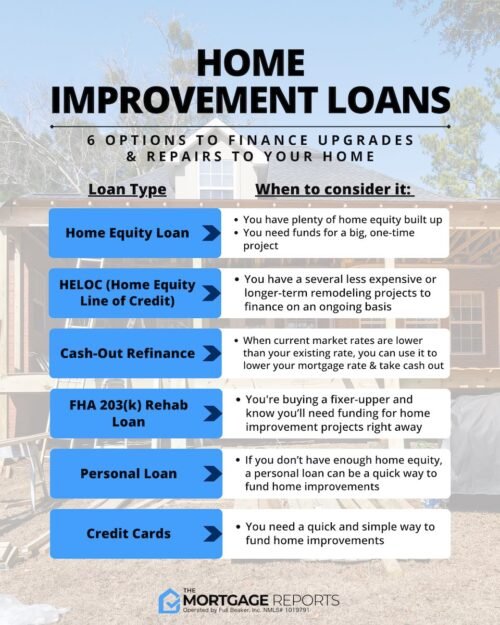
To help visualize how these products stack up, we put together a quick comparison of some common lending structures:
- Unsecured Personal Loans: Fastest funding, no collateral, higher interest rates, fixed monthly payments.
- Home Equity Loans: Lower interest rates, uses your house as collateral, slower to get through the application process.
- HELOCs (Lines of Credit): Flexible as you draw funds, interest only on what you use, but variable rates can be tricky.
- Cash-Out Refinance: Replaces your mortgage with a larger one, lowest rates, but involves significant closing costs.
Navigating the Interest Rate Maze
The math is where the excitement usually dies. Everyone loves the idea of a beautiful new deck, but nobody loves the idea of paying for that deck twice because the interest rates were too high. When you are shopping around, you will see a lot of “as low as” numbers. These are real, but they are reserved for people with impeccable credit scores and a very clean financial history. If you are looking for a more conservative entry point, unsecured home improvement personal loans can start as low as 6.74%, but you have to earn that rate through your financial profile.
The total cost of your loan is more than just the interest rate. You have to look at the APR, which includes the interest plus any fees you might be paying to get the loan in the first place. Some lenders are much more aggressive with their pricing than others. For instance, if you are looking for a smaller amount for a quick fix, Discover offers up to $40,000 with no origination fee, which is a huge deal because an origination fee can eat up several thousand dollars of your loan before you even buy your first gallon of paint.
We often talk about the “cost of capital.” When you borrow money to increase the value of your home, you have to calculate whether the home’s appreciation will outpace the interest you are paying. If you spend $40,000 on a kitchen that adds $30,000 to your home’s value, you haven’t actually made a profit in the short term, but you have gained “sweat equity” in your lifestyle. That is a subjective value that a bank will never account for in their spreadsheets.
There is also the question of the monthly payment. People often ask: “What is a $30,000 personal loan going to cost me every month?” It depends entirely on the term. If you spread that $30,000 over five years, your payment will be much higher than if you stretch it to seven years, but you’ll save a massive amount in total interest. You have to balance your immediate lifestyle needs against the long-term weight of the debt. It is a tightrope walk.
| Loan Type | Speed of Funding | Risk Level | Typical Interest Rate |
|---|---|---|---|
| Personal Loan | 1-5 Days | Low (Unsecured) | Higher (6% – 36%) |
| Home Equity Loan | 2-6 Weeks | High (Secured) | Lower (7% – 12%) |
| HELOC | Variable | High (Secured) | Variable |
Comparing Lender Philosophies
Not all banks want the same thing from you. Some lenders are like marathon runners, looking for the long-term, steady relationship where you might also have your mortgage and savings with them. Others are more like sprinters, looking to get the loan out the door and collect the interest. Understanding which type of institution you are dealing with can change your entire negotiation strategy.
If you are a member of a credit union, you might find a more tailored approach. For example, Navy Federal has many options to help finance home projects, including renovations and even emergency repairs, which is specifically helpful when the furnace dies in the middle of a January blizzard. Credit unions often have slightly more flexible underwriting standards because they are member-owned, which means they aren’t answering to Wall Street shareholders in the same way a massive commercial bank is.
Then you have the big national banks. They have the most seamless digital interfaces and the fastest approval processes, but they can be incredibly rigid. If you don’t meet their exact criteria, their computer system will simply say “no” without any human intervention. There is no arguing with an algorithm. You might spend three days gathering your tax returns only to find out your debt-to-income ratio is 0.1% too high for their automated model.
We have found that the “best” way to borrow money isn’t a single answer, but rather a process of elimination. You start with the lowest interest rate possible (usually home equity) and then work your way up to the most expensive and flexible option (unsecured personal loans) as the project requirements change. If you are doing a full-scale addition, you want the equity. If you are just replacing a dishwasher, you want the personal loan.
It is also worth noting that some people try to get creative with tax deductions. There is a common question: “Is a personal loan for home improvement tax deductible?” Usually, the answer is no, unless the loan is used specifically to buy, build, or substantially improve the part of your home that secures the loan. If you use a personal loan to renovate a kitchen, you might be able to deduct the interest as mortgage interest, but you have to be extremely careful here because the IRS is not known for its sense of humor for home office or home renovation deductions.
The complexity of these rules means you should probably talk to a tax professional rather than just guessing. We have seen people try to claim deductions on general repairs that didn’t actually increase the basis of the home, which ended up costing them more in audit headaches than they saved in tax breaks. It is a classic case of trying to save a dollar and losing a ten-dollar bill.
The Psychology of the Remodel
Money is rarely just about the numbers; it is about how those numbers make you feel when you walk into your living room. There is a specific type of psychological relief that comes from seeing a finished product that you previously only saw in magazines. It changes the way you interact with your own home. A cramped, dark kitchen can make a person feel constantly rushed and stressed, whereas a bright, open layout can actually improve your daily mood.
But there is a dark side to this too. “Scope creep” is the silent killer of home renovation budgets. You start out wanting to paint the walls, then you think the baseboards look a little dated, then you realize the flooring is actually quite old, and suddenly you are $15,000 over your budget and three months behind schedule. This is why many seasoned renovators suggest taking out slightly more than you think you need, or at least having a very substantial contingency fund sitting in a high-yield savings account.
When you are looking at a $30,000 loan, don’t just think about the principal. Think about the contractor’s timeline. If they hit a snag, and they always do, whether it’s unexpected mold or a structural beam that isn’t where the blueprints said it would be, you need to have the liquidity to handle that pause. A personal loan is great for this because the money is often available in a lump sum, but if you haven’t planned for the “surprises,” that lump sum will disappear faster than you can say “renovation nightmare.”
Financing your home improvement project is a balancing act between your immediate desire for a better lifestyle and your long-term need for financial stability. It is a tool, and like any tool, it can be used to build something beautiful or to tear something down. Use it with intention and don’t let the shiny finishes distract you from the actual math of the interest rates.
Don’t let a beautiful kitchen become a debt-ridden nightmare. texasloanstoday.com covers this in more detail.
